What changes with JMHZ?
The Unified Monthly Employer Report Czech Republic, usually referred to as JMHZ, introduces a new monthly reporting model for Czech employers from 2026.
For employers, the practical impact is simple: payroll data, employee registration and monthly statutory reporting need to be much more disciplined. The monthly report is no longer just a final output after payroll is closed. It depends on whether employee data is complete, correctly registered and ready on time.
In plain English: JMHZ turns Czech payroll reporting into a monthly data-control exercise. If employee data is late or messy, the report becomes messy too.
Employers can also refer to the official ČSSZ user guide for JMHZ on the ePortal for technical submission guidance.
This is especially important for international employers using external payroll providers, global payroll platforms or shared-service structures. The filing may be done locally, but the responsibility for correct and timely employer reporting remains with the employer.
Who must file the monthly JMH?
The obligation to file JMH applies to employers. From 2026, any employer with at least one employee needs to understand whether and how the reporting obligation applies.
Where an employer has more than one payroll office, each payroll office files the JMH separately for the employees it covers. This matters for larger companies, branches and employers with more complex payroll administration structures.
Monthly JMH deadlines
JMH is filed monthly. The standard filing window is from the 1st to the 20th day of the calendar month immediately following the month to which the report relates.
If the 20th day falls on a weekend or Czech public holiday, the deadline moves to the next working day.
File JMH in the month following the payroll period.
If the 20th is not a working day, the filing deadline shifts forward.
January, February and March 2026 are filed separately between 1 April and 30 June 2026.
The JMH for April 2026 follows the standard monthly filing window.
Zero income does not automatically mean no report. If employees are registered but had no income in the relevant month, a zero report is filed. If the employer has no registered employees, there is no JMH to file for that month.
Employee registration: the part employers must not underestimate
JMHZ is not only about the monthly report. It also changes the operational pressure around employee registration. The monthly report only works if employees and their employment details are correctly registered first.
Employee registration timeline in 2026
| Period | Practical employer rule | What to watch |
|---|---|---|
| 1 April–30 June 2026 | Transitional regime. Standard employee registration is generally handled within 8 days. Foreign employees must be registered before starting work. | This is the adjustment period. Employers should clean up workflows, access rights and data handovers. |
| From 1 July 2026 | New employees must be registered before they start work. | No more “we will fix it after payroll” mindset. HR and payroll timing must be aligned before day one. |
| Changes and corrections | Employee data changes and corrections must be reported properly through the registration process. | Wrong employee master data can flow directly into monthly reporting. |
| Terminations | Employment endings must be reported on time. | Late leaver processing can affect whether the employee appears correctly in the monthly reporting cycle. |
Practical translation: from July 2026, employee onboarding becomes a compliance deadline, not just an HR admin task.
This is a major point for global employers. If hiring data sits in Workday, an HR ticket, an email chain or a local spreadsheet for too long, payroll may not have enough time to register the employee correctly before work starts.
What does JMH include?
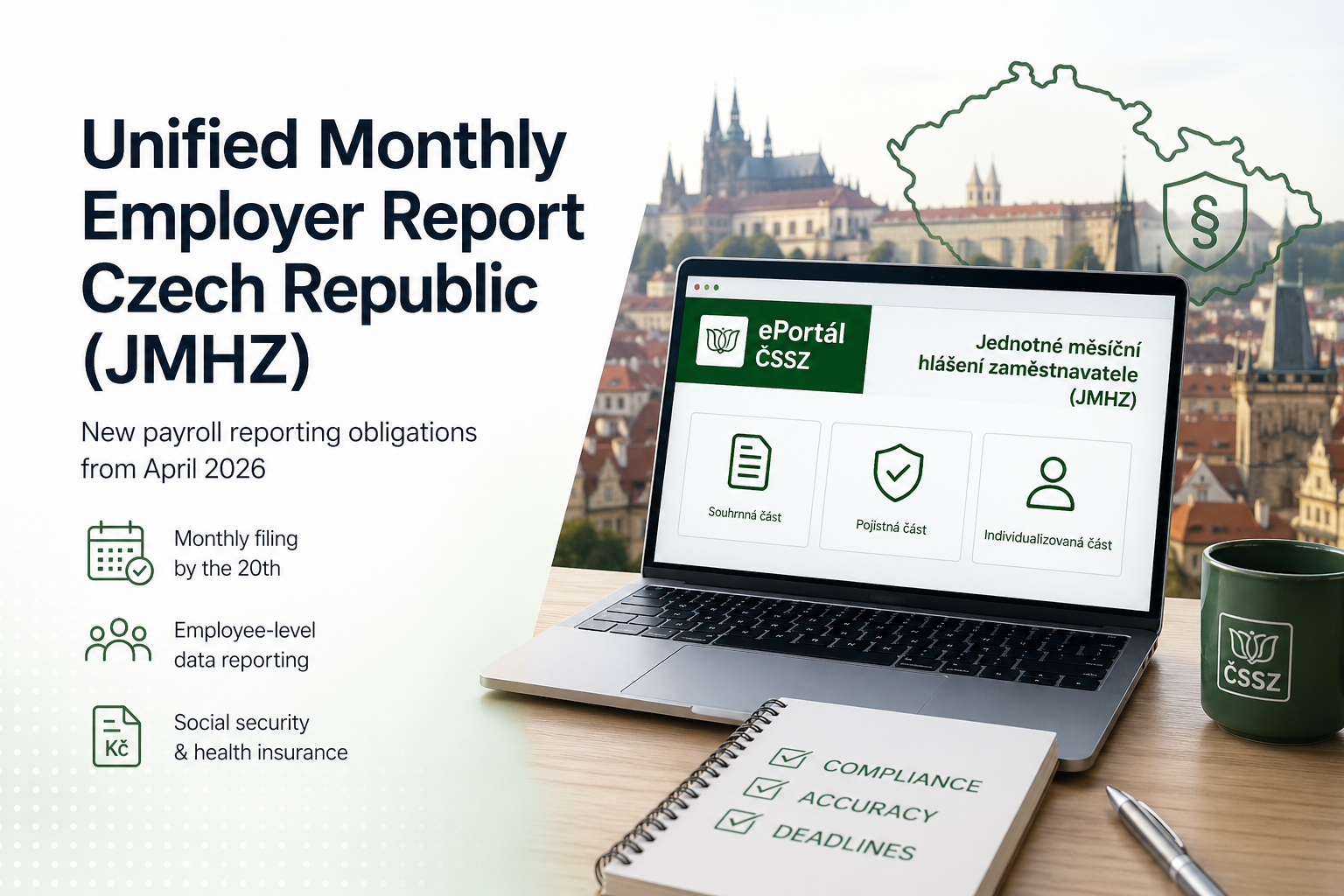
The monthly JMH has three core parts. Employers need to understand all three, because they connect employer-level data, insurance reporting and employee-level payroll details.
- Summary part — employer-level data, including information relevant for tax purposes.
- Insurance part — social security insurance information and employer contribution data.
- Individualized part — data relating to individual employees and individual employments.
The individualized part is where the real operational discipline sits. It means monthly reporting depends on accurate employee-level payroll data, not only on totals.
For employers, this shifts Czech payroll away from “monthly calculation plus later cleanup” toward a cleaner monthly control cycle.
Employer checklist: what to fix before it becomes painful
JMHZ is manageable if the employer has clean processes. It becomes stressful when payroll relies on late inputs, unclear ownership and manual fixes.
1. Confirm who owns Czech payroll reporting
Payroll provider? HR? Finance? Local manager? Global payroll team? Someone must own the complete chain — not just the upload.
2. Align HR and payroll cut-offs
If employees must be registered before work starts, HR and payroll cannot operate in separate timelines. New hire information must reach payroll early enough to be usable.
3. Review foreign employee onboarding
Foreign employees are the area where mismatches happen easily: names, dates of birth, identifiers, residency details, citizenship and personal data can all delay registration if not captured correctly.
4. Test employee-level payroll data
JMHZ is not only about aggregate amounts. Employers should check whether their payroll system can produce clean employee-level data for the report.
5. Build a monthly control routine
Before filing, employers should review whether all employees are registered, whether leavers are processed, whether changes are reflected and whether the monthly report makes sense.
Bottom line: JMHZ does not make Czech payroll simpler. It makes weak payroll processes easier to see.
Why this matters for global employers
Global employers often treat local payroll reporting as a local execution task. JMHZ makes that approach risky.
The employer still needs to understand the reporting calendar, registration duties, employee data requirements and payroll provider responsibilities. Outsourcing the process does not outsource the compliance risk.
The companies that handle JMHZ best will not be the ones with the fanciest payroll platform. They will be the ones with clear ownership, timely data and local Czech payroll logic under control.
Need an independent review of your Czech payroll setup?
CzechPayroll.com helps global employers understand Czech payroll obligations, review local payroll logic and identify reporting risks before they become operational problems.
Discuss Czech payroll complianceFAQ: Unified Monthly Employer Report Czech Republic
What is the Unified Monthly Employer Report in the Czech Republic?
The Unified Monthly Employer Report, known as JMHZ, is a Czech monthly employer reporting framework introduced from 2026. It requires employers to report selected payroll and employment-related data every month.
What is the monthly JMH filing deadline?
JMH is filed from the 1st to the 20th day of the month following the payroll period. If the 20th falls on a weekend or Czech public holiday, the deadline moves to the next working day.
What is the transitional deadline for January to March 2026?
JMH reports for January, February and March 2026 must be submitted separately between 1 April and 30 June 2026.
When must new employees be registered?
During the transition period from 1 April to 30 June 2026, standard registration generally follows the transitional 8-day regime, while foreign employees must be registered before starting work. From 1 July 2026, new employees must be registered before they start work.
Does the employer file JMH if employees had no income?
Yes, if the employer has registered employees who had no income in the relevant month, a zero report is filed. If the employer has no registered employees, JMH is not filed.
Why does JMHZ matter for global employers?
JMHZ increases the need for accurate employee master data, timely employee registration, clean payroll inputs and clear ownership of Czech payroll compliance. It is not only a payroll software change.