Czech Employee Benefits & Allowances in Czech Payroll — Statutory Rules & Taxable Treatment

Czech Employee Benefits & Allowances in Czech Payroll

For foreign employers hiring in Czechia: what counts as taxable income, what remains exempt, and what must appear on the payslip — with statutory rules and payroll treatment explained.

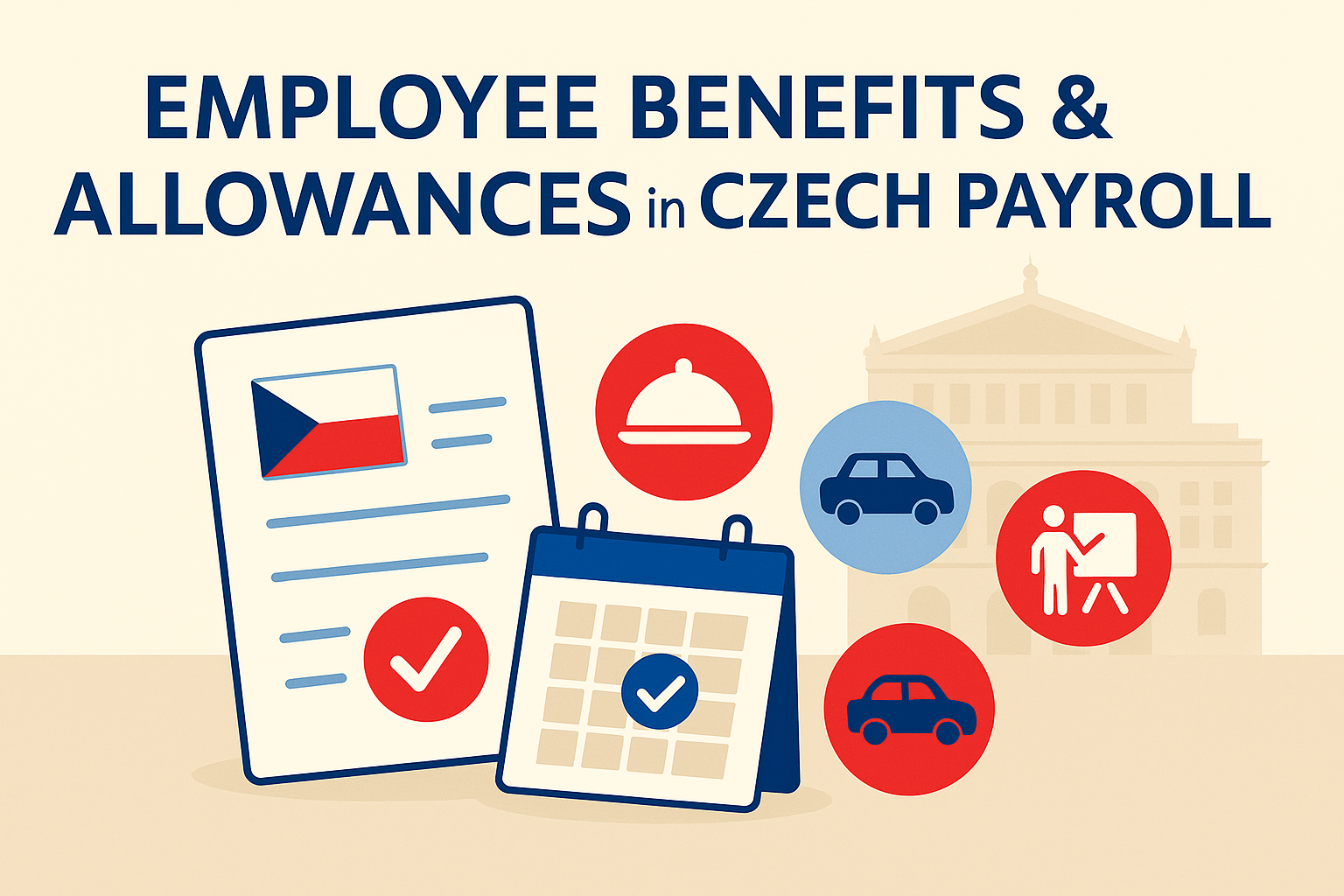
Employee benefits and allowances in Czech payroll — banner with payroll document, calendar, and benefit icons in Czech colors with Prague landmark silhouette.
Category: Payroll Compliance Reading time: 8–11 min Updated: 4 Oct 2025

Czech employee benefits are treated in payroll according to whether they are statutory reimbursements, taxable perks, or documented business expenses. This guide explains the payroll impact, tax treatment, and the documentation you should keep.

1) How Czech payroll treats benefits and allowances

In the Czech payroll context, benefits and allowances split into three practical groups: (a) statutory reimbursements and allowances (typically tax-exempt within legal rules), (b) non-cash or cash benefits that may be partially exempt or fully taxable, and (c) business expenses that should not enter payroll at all when reimbursed against proper documentation. Getting the categorisation right prevents under/over-taxation and avoids insurer/tax corrections.

2) Statutory reimbursements (generally tax-exempt within limits)

  • Business travel reimbursements: per diem/meals, accommodation, mileage or public transport — tax-exempt if paid per the Labour Code and supported by travel orders and receipts.
  • Work-related medical checks & mandatory training: employer-paid statutory checks/certifications are not taxable income for the employee.
  • Remote-work/operational expenses: when reimbursing demonstrable work expenses under an internal policy, amounts are typically outside taxable income (keep documentation and caps aligned with law/policy).

3) Common benefits — taxable vs. exempt (payroll view)

Benefit / AllowanceTypical Payroll TreatmentPayslip / Reporting Notes
Meal support (vouchers/cards) May be tax-advantaged within statutory limits; excess is taxable income. Show taxable portion in gross; track exempt portion under a non-taxable row if your payslip format supports it.
Transport subsidy / commuting Usually taxable if it is a general perk; specific documented business travel remains tax-exempt. Separate regular commuting benefit (taxable) from business travel reimbursement (exempt).
Company phone/laptop for work Business use is not taxable; non-negligible private use can be treated as taxable benefit. Keep an internal policy on acceptable private use; document asset assignment.
Training / language courses Job-related training is not taxable; purely personal courses are taxable. File training purpose and manager approval; keep vendor invoices.
Medical / sport / culture benefits Tax treatment depends on instrument and legal limits; beyond limits usually taxable. Use a benefits platform or ledger to track annual limits per employee.
Home-office allowance / remote-work reimbursement Non-taxable when paid as a statutory per-hour flat rate or as a documented reimbursement linked to actual work costs under an internal policy. Taxable if paid as a general monthly cash stipend unrelated to hours or costs. Keep records: written remote-work agreement, eligible hours, applied rate, receipts/policy. On the payslip, show non-taxable reimbursement separately from any taxable cash allowance.
Company car (private use) Taxable non-cash income per statutory methodology (value-in-kind). Maintain car assignment records; reflect value-in-kind on the payslip.

4) What should not be processed as taxable payroll

Ensure teams distinguish between a benefit and a business expense. Properly documented business costs (e.g., client lunches, business travel, work tools) are company expenses reimbursed outside the taxable payroll base. Use clear expense policies, receipt requirements, and cost-centre routing to prevent accidental payroll taxation.

5) Controls to add before month-end close

  • Classification check: benefit vs. reimbursement vs. business expense — verify ledger mapping before payroll cut-off.
  • Limits & caps control: annual/monthly caps (e.g., meal support, wellness budgets) and split taxable/exempt portions.
  • Documentation control: travel orders, receipts, asset handover forms, internal approvals.
  • Payslip clarity: separate taxable vs. non-taxable rows; keep descriptions understandable for employees.
  • Vendor coordination: align HRIS/benefits export with payroll import — fields, codes, and period mapping.

6) Practical example scenarios

  • Hybrid employee with meal support and remote-work reimbursement: part of meal support may be tax-advantaged within limits; remote-work reimbursement stays outside taxable income if policy-based and documented.
  • Remote-work reimbursement vs. cash allowance: documented home-office costs or a statutory per-hour flat rate are non-taxable; a general monthly “home-office stipend” without linkage to hours/costs is taxable income.
  • Training budget: job-related course is not taxable; a personal hobby course is taxable and should appear in gross income.

Need a clear, practical handbook?

Get the Czech Payroll Guide — plain-English rules, worked examples, and month-end controls to keep benefits and allowances compliant.

Disclaimer: This article provides general information. Always confirm current limits and legal definitions before payroll close; tax and insurance rules may change.

Czech Payroll Reporting — Authorities, Due Dates, Payments & 2026 JRF

Czech Payroll Reporting — Authorities, Due Dates, Payments & 2026 JRF

Czech payroll reporting obligations — clean, reusable guidance for HR & Payroll: who you report to, what you submit, when you pay, and how to keep evidence — plus a concise 2026 JRF outlook.

Czech payroll reporting — authorities, due dates, payments, and Prague skyline

Summary Month-end reporting at a glance

  • Czech payroll reporting obligations involve three streams: ČSSZ, each health insurer, and the Tax Office (advance withholding).

  • Monthly due day: by the 20th of the following month (next business day if weekend/holiday).

  • Annual: ELDP due 30 April; employee tax reconciliation by 31 March.

  • Payments: remain separate per stream; use correct variable symbols and bank accounts.

  • Evidence: portal receipts + bank proofs + approval log filed by month/entity.

  • 2026 JRF: reporting consolidates via ČSSZ ePortál; payments remain separate.

1) Main authorities & responsibilities

In czech payroll reporting obligations, employers coordinate with three institutions that each have distinct forms, deadlines, and payment references.

AuthorityScopeWhat it means for payroll
ČSSZ (Social Security) Employer registration; monthly insurance reporting; ELDP (annual employee records) Track assessment caps and apply HPP/DPP/DPČ rules correctly; submit and pay on time
Health insurance funds Monthly health insurance reporting and payments to each employee’s insurer Check minimum assessment base months; process insurer changes promptly
Tax Office Advance income tax withheld from employees; annual reconciliation/confirmations Remit withheld advance tax monthly; complete annual employee tax reconciliation on request

Tip: Before each month-end, confirm IDs, insurer codes, and payment references match current records.

2) Monthly reporting & payments — practical workflow

  1. Close inputs — freeze HR changes, attendance, and benefits before calculation.
  2. Calculate payroll — verify gross→net, tax credits, social/health contributions, and contract thresholds.
  3. Prepare reports — ČSSZ + health insurer files; totals agree with payroll output.
  4. Submit & archive receipts — submit via portals; save confirmation PDFs.
  5. Execute payments — bank transfers with correct symbols (maker–checker approval).
  6. Reconcile & file — archive submission receipts with bank proofs in the month folder.

Exact due-day examples (2025 practice)

ItemDue dayNotes
ČSSZ monthly report + social insurance payment By the 20th of the following month Submit via ePortál ČSSZ; store receipt hash/ID with month docs
Health insurer reports + payments (each fund) By the 20th of the following month Pay each insurer separately; verify minimum assessment base applicability
Withholding (advance) income tax payment By the 20th of the following month No monthly tax statement; pay to your Tax Office account with correct variable symbol

If the 20th falls on a weekend or public holiday, use the next business day.

3) Annual reporting & key deadlines

  • ELDP to ČSSZ: submit annual employee records by 30 April for the prior year; verify insured periods and IDs.
  • Employee tax reconciliation: process employee requests and issue confirmations by 31 March of the following year.
  • ISPV/statistics (selected employers): follow the survey schedule; validate mapping of pay elements and job codes annually.

Operational tip Keep a one-page Reporting Calendar

  • Owners & backups per authority and portal

  • Deadlines, bank references, and evidence list

  • Review each January and after legislative changes

4) Payments & bank references

Payments remain separate for each stream — ČSSZ, each health insurer, and the Tax Office (withheld/advance tax). Use the correct bank accounts and mandatory symbols to avoid misallocation. Apply maker–checker approvals in banking and log approvals alongside payment proofs. File payment confirmations with corresponding submission receipts for a complete audit trail.

Need clear examples?

Download the Free Czech Payroll Basics Guide — simple explanations and sample calculations for HR and Finance teams.

Get the Free Guide →

5) Internal controls & documentation

  • Access & roles: restrict portal access; dual control for submissions and banking.
  • Consistency checks: headcount, total gross, employer cost vs. prior month; investigate variances.
  • Evidence: store export files, submission receipts, bank proofs, and approval logs by month/entity.
  • Change management: rehearse the close after vendor updates or legislative changes.

6) Common errors & prevention

  • Missed insurer change: use a joiner/mover/leaver checklist that flags insurer updates before reporting.
  • Unmapped benefit codes: validate code-to-report mapping after any HRIS/payroll change.
  • Wrong payment reference: template the bank order with fixed symbols and a second checker.
  • Evidence gaps: enforce a “no close without receipts + bank proofs” rule.

Need a detailed handbook?

Get the Czech Payroll Guide — plain-English explanations, checklists, and examples to keep payroll compliant throughout the year.

Open the Guide →

7) 2026 note — Unified Employer Report (JRF)

From January 2026, the Czech system is scheduled to introduce a unified employer report (JRF) submitted via the ČSSZ ePortál. The JRF consolidates data previously sent separately to ČSSZ, health insurers, and the tax administration. Reporting routes unify, while payments remain separate to the usual accounts.

  • What to do now: confirm your payroll vendor’s JRF export readiness; pilot test in late 2025.
  • Controls: keep dual checks during early 2026 (totals parity, insurer splits, tax values).
  • Documentation: update the Reporting Calendar and code mapping sheet for the new format.

Disclaimer: General information for payroll operations in the Czech Republic. Always verify current forms and dates before closing payroll.

Czech Payroll Audit: A Practical Guide
Compliance & Controls

Czech Payroll Audit: A Practical Guide

Czech Payroll Audit: A Practical Guide is your essential reference for understanding how Czech payroll audits work, why they matter, and how to run them effectively.

Czech Payroll Audit: A Practical Guide – Prague Orloj themed featured image

This guide helps you verify gross-to-net calculations, tax credits, social and health insurance contributions, and statutory filings. Beyond numbers, an audit protects employee trust and prevents avoidable penalties.

Quick win: Schedule a quarterly mini-audit plus a focused spot check before and after year-end processing.

What a Czech payroll audit covers

  • Gross → net calculation logic (15%/23% tax bands, caps, and rounding)
  • Correct application of tax credits and allowances per signed declarations
  • Social/health insurance treatment on HPP, DPP, and DPČ arrangements
  • Fringe benefits, reimbursements, and taxable/non-taxable split
  • Monthly/annual filings and payments to Czech authorities
  • Data retention, employee files, and audit trail quality

Why it matters

Rules change, thresholds move, and teams grow. Regular audits reduce compliance exposure, eliminate rework, and keep employee payslips consistent. For international firms, audits align Czech specifics with global reporting.

Who benefits

HR, Finance, and leadership. Employees see fewer corrections; controllers get cleaner reconciliations; auditors get faster evidence.

For added clarity, the Czech Payroll Audit: A Practical Guide framework below shows exactly what to check each month and quarter.

Common risks found in audits

  • Incorrect tax base due to missed allowances or misordered child credits
  • Misapplied insurance on DPP/DPČ (threshold logic not documented)
  • Late or missing filings; incorrect references or payment splits
  • Misclassified roles/contracts; wrong onboarding documentation
  • Poor evidence for benefits, travel reimbursements, or meal contributions

Step-by-step payroll audit checklist

  1. Scope & sampling: Define months, entities, and a risk-based sample (new hires, DPP/DPČ, bonuses).
  2. Gross→net validation: Recompute representative payslips; confirm 15%/23% taxation and any caps.
  3. Tax credits & declarations: Verify signed forms, child/study evidence, and single-claim rules.
  4. Insurance treatment: Check thresholds and employer/employee splits; reconcile to reported totals.
  5. Filings & payments: Match due dates, confirm submission receipts and bank references.
  6. Benefits & reimbursements: Validate taxable vs non-taxable treatment and receipts.
  7. Documentation: Ensure audit trail (inputs, approvals, correction logs) is complete.
  8. Findings & fixes: Classify severity, correct in-period where feasible, and document preventive actions.

Simple monthly controls

  • Deadline tracker (filings/payments) with owner + backup
  • Variance check: headcount, total gross, and employer costs
  • Exception log: retro pay, terminations, one-off bonuses

Quarterly & annual controls

  • Quarterly sampling of DPP/DPČ for threshold application
  • Reconcile cumulative taxes/insurance vs. authority receipts
  • Pre- and post-year-end spot checks; archive year-end evidence

Documentation & evidence

Keep a consistent folder structure: inputs (contracts, declarations), calculations (payslips, audit sheets), filings (confirmations, bank proofs), and controls (checklists, approvals). Good evidence shortens external audits and speeds up corrections.

Note: “Net salary” is a statutory figure; “take-home” reflects cash after personal deductions/reimbursements. See the guide below.

FAQ

What is a Czech payroll audit?

A structured review of calculations, credits, insurance, filings, and process controls to confirm compliance and prevent penalties.

How often should we run it?

Quarterly for dynamic teams; minimally once a year, with additional spot checks around year-end.

Who should lead it?

Payroll lead or Finance controller with HR support; international companies may add a global payroll coordinator.

Top mistakes?

Misapplied tax credits, missed DPP/DPČ thresholds, late filings, misclassified contracts, and weak documentation.

Related resources

Key takeaways

By following Czech Payroll Audit: A Practical Guide, HR and Finance teams can minimize compliance risks, keep payroll accurate, and maintain employee trust. Regular reviews make year-end processing easier and safeguard your company against penalties.

Next steps

Create a simple audit plan, assign owners, and log findings with due dates. Most issues are solvable within the same payroll run if caught early. If you need a neutral review, we can help.